
Buying guide · Chevrolet Bolt · Quebec
Used Chevrolet Bolt EV and EUV: the recall, the range and the right price
Official ratings, battery fix by model year, charging, winter and benchmarks for comparing prices.
By Félipe Carbone, Used Vehicle Specialist

People shop for a used Bolt for one simple reason: close to 400 km of official range, without paying new-EV money. The next question comes right away — what about the battery and that famous recall? This guide answers both, with official figures to back it up.
Our 20-second answer
- 12023 Bolt EUV if you want the last model year built, more room in the back and a model that appears in none of the three battery recall notices.
- 22020 to 2023 Bolt EV if range matters more than space: 417 km official, versus 397 km for the EUV.
- 32017 to 2019 Bolt EV if budget comes first and your trips stay under the official 383 km, which shrink in winter.
- !Key check no. 1: for a 2017 to 2022 Bolt, insist on written proof of the recall repair linked to its VIN. It has a major impact on the car's value.
Comparing used Bolts properly
When we have them in stock, our Bolts appear below, pulled straight from our inventory: each card gives the model year, the trim, the mileage, today's price and the Groupe Beaucage dealership where the vehicle is located. A vehicle that sells disappears from the list.
Before comparing prices, sort by year, mileage and proof of the recall fix: the trim alone isn't enough. The 2023 doesn't appear in the three battery recall notices analyzed below, which target the 2017 to 2022 Bolt EV and the 2022 EUV (consulted 2026-10-04). On those affected model years, checking the fix isn't a formality: demand written proof.
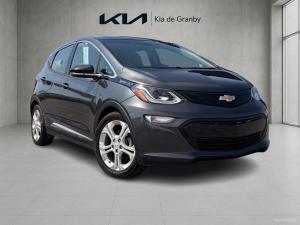

Between LT and Premier, don't go by trim alone: a high-mileage Premier can be listed for less than a lower-mileage LT. So compare vehicles with the same mileage before you compare equipment.
To check new arrivals and see the full listings: Browse the available Bolt EUVs or the available Bolt EVs.
Three periods, two body styles
In Canada, the Bolt appears in the official ratings for model years 2017 to 2023. Three periods stand out in the Natural Resources Canada data, the country's official reference:
| Model and model years | Official range | Combined consumption | Full charge, Level 2 |
| 2017 to 2019 Bolt EV | 383 km | 17.6 kWh/100 km | 9.3 h |
| 2020 and 2021 Bolt EV | 417 km | 17.8 kWh/100 km | 10 h |
| 2022 and 2023 Bolt EV | 417 km | 17.5 kWh/100 km | 7.5 h |
| 2022 and 2023 Bolt EUV | 397 km | 18.3 kWh/100 km | 7.5 h |
The 2017 to 2019 Bolt EV is the entry point. The move to 2020 lifts official range to 417 km without changing the look. The 2022 model year brings a redesigned front end, a reworked cabin and a quicker full charge, and adds the Bolt EUV, a stretched version with small-SUV styling.
The EUV isn't just about looks. According to the spec sheet published by Chevrolet for 2022, it measures 4,306 mm versus 4,145 mm for the EV, with a 75 mm longer wheelbase and 993 mm of rear legroom, versus 915 mm. Cargo space, meanwhile, is nearly identical: 462 L versus 470 L behind the rear seat. In exchange, the EUV posts an official range of 397 km, versus 417 km for the 2022 and 2023 EV.

One clarification that avoids confusion when searching: Chevrolet has revived the name with a new 2027 Bolt, announced with an estimated 422 km of range and a NACS charging port, according to chevrolet.ca. That's a different vehicle. Used Bolts from 2017 to 2023 use the CCS connector for DC fast charging; on the earliest model years, check that the unit you're considering is actually equipped with it.
The battery recall, model year by model year
The problem is documented by Transport Canada: the high-voltage battery could overheat when charged beyond 90% of its capacity, with a risk of fire. The fix isn't the same for every model year, and that's what creates confusion among buyers.
| Affected model years | Notice | Fix provided for in the notice |
| 2017, 2018 and 2019 Bolt EV | 2021-449 | Replacement of defective battery modules by GM, in addition to the fix from recall 2020-540 |
| 2020 to 2022 Bolt EV and 2022 Bolt EUV | 2021-524 | Advanced diagnostic software that monitors the battery, then module replacement if a warning appears |
| Same model years | 2024-654 | Follow-up repair for certain vehicles whose repair under a previous recall was incomplete |
| 2023 Bolt EV and Bolt EUV | None of the three | Check the VIN anyway: other notices may exist |
In other words, “the recall was done” can mean two very different things: new battery modules, or the installation of diagnostic software. In the second case, you need to know where the vehicle stands: the initial 80% charge restriction period may be over, but the software keeps monitoring the battery after the return to 100%, according to Chevrolet Canada's recall page. A GM technical bulletin (March 2024) specifies that some 2020 to 2022 Bolt EVs and 2022 EUVs remained limited to 80% charge after the roughly 10,000 km of planned monitoring, and that the dealership must then reprogram them to 100%. Ask for the mileage recorded when the recall work was carried out and check the current charge limit. According to the Automobile Protection Association (article dated September 15, 2023), GM had promised an 8-year or 160,000 km warranty starting from the installation of the replacement modules, then withdrew that extension in June 2023 for vehicles that receive only the software fix.
For you, the rule is simple: on a 2017 to 2022 Bolt, ask in writing which fix was applied, on what date and at what mileage, and what coverage has applied to the battery since. Our guide to checking a vehicle's recalls with its VIN walks through the steps.
Battery warranty: two possible starting points
GM bulletin 22-NA-119 describes two separate types of warranty coverage for 2017 to 2022 Bolts. The original electric vehicle component warranty, 8 years or 160,000 km, runs from the in-service date. Batteries and components replaced under the recall get their own 8-year or 160,000 km parts warranty, which runs from the date and mileage of the replacement and in parallel with whatever remains of the original warranty.
On a unit without a replacement, the in-service date therefore matters. Two 2022 Bolt EUVs may have entered service nearly a year apart: under the same “2022” label, their original warranties then don't expire on the same date. In every case, ask in writing for the expiry dates recorded in the vehicle's GM file, for the original warranty as well as any replacement-parts warranty.
Another line to read on the listing: the legal warranty category. It depends on the vehicle's age and mileage, from A (6 months or 10,000 km) to D: compare it from one unit to the next. It comes on top of whatever remains of the manufacturer's warranty.
Have a vehicle to trade in for a Bolt?
Have its value estimated before comparing prices. According to Revenu Québec, when an individual not registered for the GST and QST trades in their vehicle to a registered merchant, the amount allowed reduces the amount on which the taxes are calculated.
Charging: what the Bolt needs at home
First things first: until the required fix has been done on the unit, follow the interim instructions from Chevrolet Canada, including parking outside after charging and not letting the car charge overnight indoors. The VIN tells you which instructions apply.
On a regular 120-volt outlet, Chevrolet's 2022 spec sheet indicates about 6 km of range per hour plugged in. For short trips, that can be enough: check that the kilometres recovered overnight cover the ones you drive during the day. On a Level 2 charger, Natural Resources Canada lists a full charging time of 9.3 h for 2017 to 2019 models, 10 h for the 2020 and 2021, and 7.5 h for the 2022 and 2023. These times are indicative: they depend on the power actually available and on the temperature.
On the road, DC fast charging goes through the CCS connector. For 2022, Chevrolet quotes up to about 160 km of range recovered in 30 minutes for the EV and 153 km for the EUV, figures that vary with the station and the temperature. When buying, ask whether the original charging cable is included: it isn't on the listing.


Winter in Quebec
Natural Resources Canada's ratings are measured under a standardized protocol: in deep cold, an electric vehicle's real-world range drops, because the heater draws from the same battery as the motor. The Bolt is no exception. Plan your longest winter trip with a comfortable margin rather than with the official rating.
Two habits really help: preheating the cabin while the car is still plugged in, so the energy comes from the outlet and not the battery — advice Chevrolet itself gives — and driving on properly inflated winter tires. Our article on the winter range of a used electric vehicle explains how to estimate the loss based on your trips.

What to check when buying
- The VIN's recalls: Transport Canada notices, GM's lookup tool, then the written record of the recall work (date, mileage, parts or software).
- The battery warranty expiry dates: original warranty from the in-service date, and the parts-specific warranty if the battery was replaced.
- The current charge limit, especially on a 2020 to 2022 that received the diagnostic software.
- The range displayed after a full charge, as a first clue only: it varies with the temperature and recent driving, and isn't enough to judge the battery. When in doubt, ask for a battery inspection or diagnostic.
- A charging test, on Level 2 and, if possible, on DC fast charging.
- The history report: our guide to reading a CARFAX reportshows what to look for.
- Tires and brakes: regenerative braking works the brakes less, so look at the condition of the rotors as much as pad wear.
For the rest of the process, our pre-purchase inspection checklist applies to an electric vehicle too, and our tips for buying a used electric vehicle cover the battery in general. If you're torn between two models, our used Chevrolet Bolt or Nissan Leaf comparison settles it based on how you drive.
Test drive a Bolt near you
Our used Bolts are found at Groupe Beaucage dealerships, even though Chevrolet isn't one of the brands we sell new. Each listing shows the location where the vehicle is: pick a unit, then book the test drive from its listing or with the form below.
During the test drive, plug it in once, climb a hill and take a highway exit, and ask your questions about the recall with the invoice in front of you. To compare with other affordable EVs, see our ranking of used electric cars.
Book your test drive
Choose the model you're interested in and a time that suits you. An advisor will call you back to confirm the unit and the date.
Frequently asked questions
How can I tell if a used Bolt's battery has been replaced?
Check the Transport Canada notices for the model year, then look up the VIN in GM's recall search tool, which Transport Canada's Find a manufacturer page points to. Then ask for the record of the recall work: date, mileage, parts replaced or software installed. For 2020 to 2022 models, the fix may be monitoring software rather than a replacement, and only written proof settles it.
Can you charge a Bolt on a regular outlet?
Yes, but slowly: Chevrolet's spec sheet for the 2022 model year indicates about 6 km of range recovered per hour on a 120-volt outlet. If your daily trips are short, that may be enough: compare the kilometres recovered overnight with the distance you drive. On a Level 2 charger, Natural Resources Canada puts a full charge at between 7.5 and 10 hours depending on the model year, an estimate that varies with the available power and temperature.
Are the Bolts and prices in this article up to date?
The Bolts shown in this article come straight from our inventory and change with it.
Is a used Bolt eligible for a government incentive?
Maybe. According to Québec.ca, Roulez vert provides up to $1,000 in 2026 for an eligible used electric vehicle bought from a Quebec dealership and registered while the program is in effect (scheduled to end December 31, 2026). Based on its model year, the vehicle must be one to four years old, appear on the list of eligible vehicles and never have received a Roulez vert rebate, new or used. A Bolt bought new in Quebec with that rebate therefore doesn't qualify: have these conditions checked before counting on that amount.
The right Bolt, with proof of the recall fix in hand
Choose the vehicle, ask for the recall repair records, then take it for a test drive. Financing gets sorted afterwards, on site or online.


