
Electric vehicles · Maintenance · Used
Maintaining a used electric car: what is still on the schedule
The official Kia, Hyundai and Nissan schedules compared item by item, what a Quebec winter changes, and the proof to ask for before you buy.
By Félipe Carbone, Used Vehicle Specialist

No oil changes, no spark plugs, no belts. Yet open the manual of a 2020 Kia Niro EV: the coolant is replaced every 60,000 km or 36 months. On a 2024 Niro EV, the first replacement comes at 195,000 km or 120 months. Same name, two schedules: for a used electric vehicle, you need the maintenance schedule for the exact model year.
In short
- What remains:tires, brakes and brake fluid, cabin air filter, 12 V battery, coolant, reduction gear oil.
- The item to watch when buying:the coolant. On the 2020 to 2023 Kona Electric, the 2022 to 2024 Ioniq 5 and the 2020 Niro EV, the official schedules put it at 60,000 km or 36 months.
- Quebec winters affect the schedule:salt, cold and short trips are listed among Kia's and Nissan's severe-use conditions, for which some service intervals are shorter.
- Before you sign:invoices compared against the schedule for that model year, recalls checked by VIN, battery health assessed by a dealership for that brand.
What disappears, and what remains
A fully electric vehicle has no combustion engine, no engine oil and no exhaust system. Natural Resources Canada presents it as an option for anyone who wants to cut fuel and maintenance spending sharply. Engine oil changes, spark plugs and the engine oil filter disappear from the schedule.
The remaining maintenance list is shorter, but it is not empty: the three manufacturers whose Canadian documents we read all schedule a periodic visit (brakes, suspension, 12 V battery, tire rotation), the cabin air filter, brake fluid, reduction gear oil and coolant. What changes from one model and model year to the next is the timing.
Three official schedules, side by side
We compared the normal maintenance schedule intervals in the Canadian documents of three manufacturers, consulted on October 4, 2026: Kia Canada's owner's manuals for the 2020 Niro EV, the 2024 Niro EV and the 2023 EV6, Hyundai Canada's maintenance schedule tool, and Nissan Canada's 2023 LEAF owner's manual. Each interval applies at whichever comes first, kilometres or months.
| Model and model year | Basic service | Cabin air filter (R) | Brake fluid (R) | Coolant (R) | Reduction gear oil (I) |
| 2020 Kia Niro EV | 12,000 km or 12 months | 24,000 km or 24 months | 48,000 km or 48 months | 60,000 km or 36 months | 24,000 km or 24 months |
| 2024 Kia Niro EV and 2023 EV6 | 13,000 km or 12 months | 26,000 km or 24 months | 78,000 km or 48 months | 195,000 km or 120 months, then 39,000 km or 24 months | 52,000 km or 48 months |
| Hyundai Kona Electric 2020 to 2023, Ioniq 5 2022 to 2024 | 12,000 km or 12 months | 24,000 km or 24 months | 48,000 km or 48 months | 60,000 km or 36 months (low-conductivity coolant) | 48,000 km or 48 months |
| 2023 Nissan LEAF | 12,000 km or 6 months | 24,000 km or 12 months | 48,000 km or 24 months | 200,000 km or 15 years, then 120,000 km or 5 years | 24,000 km or 12 months |
Two takeaways. First, the same model name can hide two schedules: the first-generation Niro EV and the second-generation one share neither the same basic service nor the same coolant interval. Second, this table covers the model years we verified, not the others: for the unit you are considering, the reference remains the schedule in its own manual or in the manufacturer's tool.
The model year appears on every listing: it is the starting point for finding the right schedule. See the electric vehicles in stock
Coolant, the item not to miss
An EV still has a cooling system, but what it cools varies from one model to the next. In the 2023 LEAF manual, Nissan specifies that its coolant protects the electrical equipment “such as the motor and the inverter.” In the 2020 Niro EV manual, Kia asks that top-ups be left to a Kia dealership, using a coolant specified for electric vehicles; Hyundai refers to a “low-conductivity” coolant.

This is where maintenance records matter when buying used. Depending on its in-service date, a 2021 Kona Electric or a 2020 Niro EV has already passed at least one 36-month deadline. Ask for the replacement invoice: a low-mileage unit is not exempt, since the interval is also counted in months. If the invoice does not exist, get the job priced before negotiating rather than after.

Brakes: used less, not forgotten
Regenerative braking spares the pads, but the manufacturers do not conclude that the brakes can wait. Hyundai's schedule for the 2021 Kona Electric lists a front and rear brake service, parking brake included, from 24,000 km or 24 months, then at every 24,000 km visit. Kia calls for an inspection of the discs, pads and calipers at every visit on the 2024 Niro EV, and more often under severe conditions.

Nearly new pads do not eliminate the need for this replacement: on a four- or five-year-old vehicle, check the service records to confirm it was done.
Tires and 12 V battery: the two winter items
Tires. In Quebec, winter tires are mandatory from December 1 to March 15, according to the Government of Quebec. Rotation is part of every basic service in the schedules compared, every 12,000 or 13,000 km depending on the model. In its electric vehicle maintenance tips, Kia points out that correct pressure helps range. Since pressure drops with temperature, check it as soon as the first cold snaps arrive.

The 12 V battery. An electric vehicle keeps a small 12 V battery for its on-board systems, and every schedule compared calls for it to be checked. The 2024 Niro EV manual even describes a jump-start procedure with a booster battery, as on a gasoline vehicle. The 2023 LEAF manual warns that repeated use of the charging timer once charging is complete can drain the 12 V battery. When buying, ask when it was tested or replaced.

Severe conditions: a Quebec winter ticks several boxes
Each manufacturer publishes a second, tighter schedule for severe conditions. In the 2024 Niro EV manual, Kia includes driving in areas where salt is used or in very cold weather, salted roads and trips under 16 km in freezing temperatures. For the 2023 LEAF, Nissan includes roads where salt has been spread and repeated trips under 16 km below freezing.

On the 2024 Niro EV, the reduction gear oil then goes from an inspection to a replacement every 117,000 km; on the 2023 LEAF, brake fluid replacement is due at 24,000 km or 12 months. Ask the shop which schedule the vehicle followed, and which one suits your driving.
Before you buy: battery health and maintenance records
A used EV is judged on what can be proven. Five checks, in order:
- The schedule for the exact model year.Find it in the manual or in the manufacturer's tool, then compare it against the invoices, item by item: coolant, brake fluid, cabin air filter.
- The condition of the high-voltage battery.Ask for a health report produced by a dealership for that brand. Kia advertises a warranty of 8 years or 160,000 kmon the high-voltage battery of its EVs, and Nissan Canada, 8 years or 160,000 kmon that of its EVs: work out what is left from the warranty start date recorded in the file.
- The battery reports of a LEAF older than 2023.Nissan Canada states that a review of the battery usage report is required under the battery warranty for model years prior to 2023, with inspections at 12 and 24 months carried out free of charge by an EV-certified dealership. Ask for those reports.
- Recalls.Use the manufacturer's tool to search by VIN; our guide to checking recalls by VINwalks you through it.
- The inspection.Our pre-purchase inspection checklistapplies to the rest of the vehicle: body, underbody, tires, suspension.

For the full process, see our guide to buying a used electric vehicle, and our article on extended warranties if the original coverage is nearing its end.
Changing vehicles?
Have your current vehicle appraised before you shop: according to Revenu Québec, when an individual trades a vehicle in to a dealership, the trade-in value reduces the amount on which the GST and QST are calculated.
The models compared, and where to have them serviced
On each listing, first find the exact model year: it tells you which manufacturer schedule to consult, and therefore which invoices to ask for.
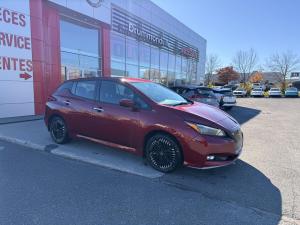
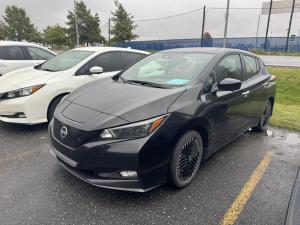






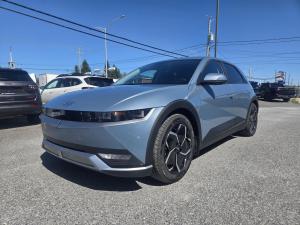
Also browse all available Nissan LEAF and Hyundai Kona Electric models, or filter by city: EVs in Sherbrooke, EVs in Drummondville, EVs in Granby.
For servicing in the region, the network includes Kia, Nissan and Mitsubishi dealerships in Drummondville, Nissan and Mazda dealerships in Saint-Hyacinthe, and a Nissan dealership in Victoriaville. Hyundai is represented in Magog. Before booking an appointment for a battery-related item, ask whether the shop is equipped and trained for the brand's EVs. Groupe Beaucage also offers prepaid maintenance plans for new or used vehicles: have them specify which items apply to an EV, since the page also lists services specific to gasoline engines.
Frequently asked questions
Is a used electric vehicle cheaper to maintain?
It requires fewer maintenance tasks: no engine oil, no spark plugs, no belt. We do not publish an annual amount, because the bill depends on the model year and on each shop's rates: ask for a written estimate based on the official schedule.
Can the cold damage the battery of an EV parked outside?
The 2023 LEAF owner's manual recommends avoiding storing the vehicle for more than seven days below –25 °C, and not leaving it more than 14 days with a charge at or near zero. For the effect of cold on day-to-day range, see our guide to the winter range of a used EV.
Do you have to get maintenance done at a dealership for that brand?
For work involving the high-voltage battery and the coolant in its circuit, manufacturers refer you to their dealerships: Kia specifies in the 2020 Niro EV manual that the coolant must be added by a Kia dealership, with a product specified for electric vehicles. For the rest, keep every invoice: that is what will prove the schedule was followed.
Compare the schedule against the invoices before you buy
The model year is written on every listing. With it, you can find the official schedule and know which invoices to ask for.


