
Comparison · Mitsubishi · Used
Used RVR or Eclipse Cross: which to choose?
Prices for the same model year, drivetrain, engine and warranty: what really separates these two used subcompact SUVs.
By Félipe Carbone, used vehicle specialist

Same brand, same continuously variable transmission on recent model years, same 10-year powertrain warranty, and prices that overlap: it is understandable to be torn between a used Mitsubishi RVR and a used Eclipse Cross. What really separates them comes down to three points: the price for the same model year, the drivetrain and the engine.
Our 20-second answer
- The RVRif you want to pay less for the same model year, park easily in town or stay within a tighter budget. The RVR also suits you if you prefer a non-turbo engine.
- The Eclipse Crossif you want all-wheel drive (the federal ratings no longer list a Canadian two-wheel-drive version after 2018; confirm on the listing or by VIN), if you often drive loaded on the highway or uphill, or if rear-seat room matters.
- For both: in Canada, the 10-year or 160,000 km powertrain limited warranty stays with the vehicle. On each listing, compare the two limits: the 10-year deadline and the remaining kilometres.
How to compare a used RVR and a used Eclipse Cross
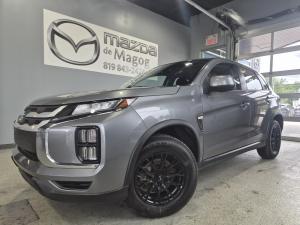
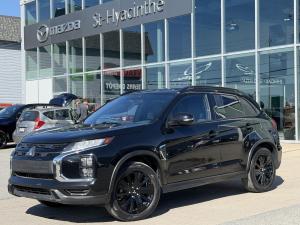
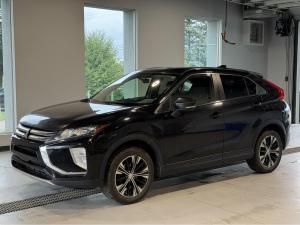
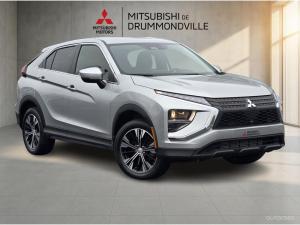
When we have them in stock, our used RVRs and Eclipse Crosses are displayed below, showing each vehicle's price, mileage and dealership. The used Mitsubishi RVR and used Mitsubishi Eclipse Cross pages also bring together the available vehicles, with filters.
To compare two listings, look first at the model year, the trim and the kilometres, then the drivetrain: for the same model year, these explain most of the price gap.
Tipping point No. 1: the price for the same model year
Comparing a 2016 RVR with a 2024 Eclipse Cross tells you nothing. For a similar model year, trim and mileage, the Eclipse Cross generally sells for more than the RVR: it already cost more new, and it comes standard with all-wheel drive and the turbo engine.
Our take: the price gap goes with real equipment differences, such as S-AWC all-wheel drive on all trims and, since 2022, standard forward collision mitigation. It’s up to you to judge whether they are worth the difference for your use.
For a small budget, the choice often leans toward the RVR: sold in Canada well before the Eclipse Cross, which appeared in 2018, and cheaper new, it is easier to find in older, more affordable model years. On an older or high-mileage unit, check the warranty deadline and the recalls (see below).
If you have a vehicle to trade in, its appraised value matters just as much as those price differences: get your trade-in appraised online before comparing two listings.
Tipping point No. 2: four-wheel drive
Natural Resources Canada’s fuel-consumption ratings list a two-wheel-drive Eclipse Cross for the 2018 model year only; for the later published model years, they list only four-wheel-drive versions. A 2019 or newer Eclipse Cross sold new in Canada should therefore have its S-AWC all-wheel drive, which Mitsubishi describes as an integrated management of stability control, anti-lock braking and active yaw control, which apportions braking and torque. Fuel-consumption ratings do not establish which vehicles were actually sold: for a specific unit, the “Drivetrain” entry on the listing or the VIN is authoritative.
The RVR, for its part, exists in front-wheel drive and in AWC all-wheel drive; on the 2022 spec sheet, front-wheel drive is offered only on the ES and SE trims, with the 2.0 L engine, and the AWC drivetrain comes with a mode selection control (2WD, 4WD AUTO, 4WD LOCK). The “Drivetrain” entry on each listing settles the question in a second.

Our take: a front-wheel-drive RVR with good winter tires remains a reasonable choice for city driving and main roads that are cleared early. For a country road, a sloped driveway or departures before the plow comes through, aim for an AWC unit, or a 2019 or newer Eclipse Cross, listed in S-AWC only.
Tipping point No. 3: turbo torque or a non-turbo engine
According to the Canadian spec sheet of the 2023 Eclipse Cross, its 152 hp 1.5 L turbo delivers its maximum torque of 184 lb-ft from 2,000 rpm. The RVR relies on non-turbo engines: according to its 2022 Canadian spec sheet, a 148 hp 2.0 L (145 lb-ft) on the ES and the front-wheel-drive SE, or a 168 hp 2.4 L (167 lb-ft at 4,100 rpm) on the SE AWC, the SEL, the LE and the GT.
In practice, the Eclipse Cross needs fewer revs to pass a truck or climb a hill with four adults aboard. The RVR makes up for it with a non-turbo engine, appreciated by those who keep a vehicle a long time. The difference in fuel consumption is small: 8.8 to 9.4 L/100 km combined rating for the RVR depending on the engine and drivetrain, 9.3 L/100 km for the Eclipse Cross, both on regular gasoline.
To see the RVR on the road before your visit, a road test filmed in Quebec:

Video: road test. It shows the 2020 RVR, whose front end is the same as on the 2020 to 2024 RVRs.
Size, cargo space and rear-seat room
Mitsubishi lengthened the Eclipse Cross by 140 mm for 2022, including 105 mm at the rear, according to its Canadian press release of December 15, 2020. Result: a bit more cargo space and rear legroom, but a longer vehicle to park.
| Feature | RVR | Eclipse Cross |
| Engine | 148 hp 2.0 L (145 lb-ft) or 168 hp 2.4 L (167 lb-ft) | 152 hp 1.5 L turbo (184 lb-ft from 2,000 rpm) |
| Transmission | continuously variable | continuously variable |
| Drivetrain | front-wheel drive (ES and SE) or AWC all-wheel drive | S-AWC all-wheel drive on all trims |
| Combined fuel use | 8.8 to 9.4 L/100 km depending on the engine and drivetrain | 9.3 L/100 km |
| Length | 4,365 mm | 4,547 mm |
| Cargo space (rear seat up / folded) | 614 L / 1,402 L | 663 L / 1,419 L |
| Rear legroom | 921 mm | 943 mm |

On a 2019 to 2021 Eclipse Cross, the dimensions differ: it is the pre-facelift body, shorter, with a rear window split in two by a bar.

The 10-year warranty: it follows the vehicle, but the clock is running
An often misunderstood selling point. On its warranty page, Mitsubishi Motors Canada answers the second-owner question this way: “In Canada, the warranty stays with the vehicle and does not need to be transferred.” Mitsubishi also states that the second owner must provide their name and address to Mitsubishi Motor Sales of Canada.
Three nuances to keep in mind:
- It is a limited10-year or 160,000 km warranty, coverage ending at the first limit reached. It starts from the new vehicle’s warranty start date, not from your purchase date.
- Among other things, Mitsubishi excludes damage caused by poor maintenance or failure to follow the recommended schedule: ask for the maintenance invoices for the vehicle.
- The 5-year or 100,000 km basic warranty follows the same logic of duration and kilometres: on most 2022 and older units, it has already expired or nearly so.
For each unit, compare the two limits: the 10-year deadline and the 160,000 km ceiling. A high-mileage unit may have only a few thousand kilometres of coverage left, and an older one may have passed its 10 years even with few kilometres. Each listing also shows its legal warranty class (A, B, C or D): our guide to the legal warranty on a used vehicle in Quebec explains what it covers.
Recalls to confirm by VIN
Transport Canada’s database, consulted on October 4, 2026, lists for these two models in particular:
- 2019 to 2022 RVR: recall 2022420, a reprogramming of the continuously variable transmission module (17,882 vehicles affected in Canada).
- 2018 and 2019 Eclipse Cross: recall 2018507, a software update to the forward collision mitigation system.
- 2016 RVR: eight safety notices, including one on corrosion of the front crossmember by road salt.
The 2016 to 2024 RVRs and the 2018 to 2024 Eclipse Crosses also appear under a notice about the unilingual compliance label; Transport Canada specifies that this is not a recall and has no safety impact. This database lists recalls by model and by year, not by unit: for a VIN search, Transport Canada refers to Mitsubishi’s recall lookup tool. Our article on checking recalls by VIN details the steps.
What to check on the test drive, for each
Mitsubishi RVR
- Accelerate firmly on a highway on-ramp: the continuously variable transmission raises the revs, which is normal; a jerk or slipping is not. On a 2019 to 2022, have the reprogramming of recall 2022420 confirmed.
- On an AWC unit, find the mode selection control and check that the indicator responds.
- Read the equipment list: depending on the year and trim, forward collision mitigation and blind-spot monitoring are not always present.

Mitsubishi Eclipse Cross
- Climb a hill at low speed: acceleration should stay firm and smooth, with no warning light on or abnormal behaviour. At the slightest doubt, have the vehicle inspected.
- On a 2018 or a 2019, judge the rear view through the split window, and have the update for recall 2018507 confirmed.
- Try the drive modes (Auto, Snow and Gravel on the 2023 sheet) and check that the 8-inch screen (2022 and later) connects to your phone.
For both: inspect the crossmembers and subframes underneath the vehicle, where salt damage tends to appear first.
Who should choose which
The RVR is the better choice if…
- you want a recent model year on a tighter budget;
- you drive mostly in town and park on the street;
- you prefer a non-turbo engine.
The Eclipse Cross is the better choice if…
- you live on a country road or a sloped street and all-wheel drive is non-negotiable;
- you drive long distances loaded, with the family;
- you want standard forward collision mitigation (2022 and later).
Where to see them for a test drive
Our used RVRs and Eclipse Crosses are found at Groupe Beaucage dealerships, notably Mitsubishi Drummondville and Mitsubishi Granby. Each vehicle listing identifies the dealership: confirm it before making the drive.
To test drive both models on the same day, choose a dealership that has both in stock. Vehicles are sold and added every week: check the used RVR and Eclipse Cross pages or browse the full Mitsubishi inventory to see what is available today.
Before you decide, our ranking of the best used subcompact SUVs compares five other SUVs of the same size (Kicks, Kona, Seltos, CX-30, Venue) if you want to widen the search, and our guide to the used Outlander covers the seven-seat big brother.
Book your test drive
Choose the model you’re interested in and the time that suits you. An advisor will call you back to confirm the unit and the date.
Frequently asked questions
Are the vehicles shown in this article up to date?
Yes. The RVRs and Eclipse Crosses shown in this article come directly from our inventory and change with arrivals and sales. Each vehicle’s listing shows its current price and mileage.
Does the 10-year warranty apply if I am the second owner?
Yes, according to Mitsubishi Motors Canada: in Canada, the warranty stays with the vehicle and does not need to be transferred. It remains limited to 10 years or 160,000 km from the start of the new vehicle’s warranty, whichever limit is reached first, and neglected maintenance can result in some damage being excluded from coverage.
Is there a front-wheel-drive Eclipse Cross?
Natural Resources Canada’s fuel-consumption ratings list one for the 2018 model year only; the later published model years appear there only in four-wheel drive. A rating does not establish which vehicles were actually sold: for a specific unit, check the “Drivetrain” entry on the listing or have the VIN decoded.
Compare them on the road
Test drive both models to compare their comfort and handling.


